Coventry Climax FW Range
Specialist engine building and parts supply for the FWA, FWB and FWE engine family.
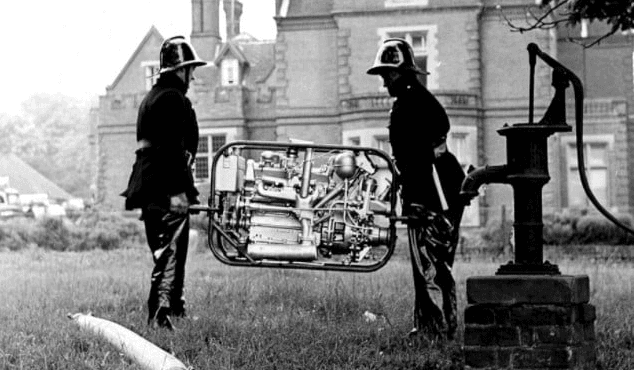
The Coventry Climax FW Engine
Originally designed in 1950 by Walter Hassan and Harry Mundy to meet a Government requirement for a 35 bhp 3,500 rpm engine to drive a portable fire pump. Three initial contracts to supply 150,000 engines were delivered by a 1020cc lightweight aluminium unit, 180 lbs in weight with maintenance free valve adjustment under an overhead camshaft. This engine was displayed at London Motor Show and attracted much interest from the racing fraternity.
FWA — The First Automotive Engine
In 1953 after the interest from the racing fraternity a 1098cc engine was produced and Keift were the first manufacturer to fit an FWA (Featherweight Automotive) engine into the Keift–Climax that ran at Le Mans 24 hour.
To take full advantage of the 1100cc class limit, the FW's bore was increased from 2.75 to 2.85 inches, raising displacement to 1097cc; the 2.625-inch stroke was left unaltered. The crankshaft was switched to tougher forged steel in place of the FW's cast iron. Compression was raised from 7.4 to 8.8:1, and ports, valves, and valve pockets were enlarged to the practical limit. A distributor replaced the magneto ignition, and carburetion was upgraded to twin SUs. These changes doubled output to 71 horsepower at 6000 rpm. Colin Chapman also saw this engine and installed a Climax FWA into a Lotus VIII making for an extremely lightweight combination. John Exley Eng restored this engine to period spec when the car was restored in 2010. These FWA engines went on to be fitted to Lotus XIs making for a very quick lightweight sports car.
FWB — Formula 2
In anticipation of the new-for-1956 1500cc Formula 2 class, car builders knocked on CC's door for competitive engines. Happy to oblige, Hassan increased the FWA's bore and stroke to raise displacement to 1460cc and output to 108 horsepower. Water passages between the first and second, and third and fourth, cylinders had to be eliminated to accommodate the new 3.0-inch bore, but durability testing revealed no cooling issues. The compression ratio was raised to 11.4:1. When reliability issues were discovered during testing, the redline was dropped to 6500 rpm. The U.S. marine enterprise Bearcat also used an FWB in its outboard motors.
FWE — The Lotus Elite Engine
Along with the FWA and FWB came the 1216cc variant for the Lotus Elite Type 14, released in 1957, fitted to the first production fibreglass monocoque chassis, encapsulating Chapman's philosophy of achieving blistering performance through minimum weight. This edition of the FW combined the original FWA crankshaft with an FWB block. A 3.00-inch bore with a 2.625-inch stroke yielded 1216cc (often rounded to 1220cc). The Stage I version with 10.0:1 compression, a low-lift camshaft, and a single SU carburettor produced a modest 70 horsepower. Adding a second SU in Stage II yielded 81 horsepower. The Stage III version climbed to 96 horsepower with more aggressive valve timing and lift. Fitting a tubular-steel exhaust manifold and a ported head with an 11.1:1 compression ratio for track use topped out the FWE at a potent 105 horsepower. These engines can now be built to achieve 140 bhp and turn a Lotus Elite into a giant killer on the circuits.
Possibly the Lotus 17, released in 1959, became the ultimate 1216cc race car. A fibreglass body, extremely low frontal area and a declared dry weight of 340 kg — it was seen as the ultimate evolution of Chapman and Len Terry's work, creating a very effective weapon.
Coventry Climax FW Parts
John holds a stock of original and hard-to-find Coventry Climax FW parts. Browse the current catalogue or get in touch directly if you're looking for something specific.
Please contact John for any Coventry Climax engine requirements.